Fence Gate Problems: Sagging, Dragging, and Gates That Will Not Latch
Gates fail before the rest of the fence, and they fail for a reason that has little to do with the gate itself. A fence panel sits between two posts and is supported at both ends. A gate hangs off one post and is supported at one end, which means that post fights a lever all day, every day, for the life of the fence.
Understanding that makes almost every gate problem easier to diagnose.
First, Diagnose It Properly
Nearly every gate complaint falls into one of two categories, and they have completely different fixes. Open the gate and look at the gap on the latch side.
| What you see | What it means | Fix |
|---|---|---|
| Gap is wedge-shaped, wider at top | Hinge post is leaning | Reset or replace the post |
| Gap stayed parallel, gate dropped | Frame racked or hinges worn | Anti-sag cable or new hardware |
| Gate binds only in wet months | Soil movement or swelling | Drainage, sometimes clearance |
| Latch misaligned but gate square | Latch post moved | Reset latch post or reposition hardware |
Sighting down the hinge post against a vertical reference like the corner of the house will confirm a lean quickly. A four-foot level held against the post works too.
The Leaning Gate Post
This is the most common cause and the one people most often try to fix the wrong way. Shimming the hinges, adding a wheel to the bottom of the gate, or planing the latch edge all address the symptom while the post keeps rotating.
Gate posts lean for a short list of predictable reasons. The post was the same size as the line posts when it should have been larger. It was set at line-post depth when it needed to go deeper. It was set in concrete that holds water rather than sheds it, so the wood at the soil line softened. Or the gate is simply heavier or wider than the post was ever sized for.
The real fix is resetting the post, usually a size up, deeper, over gravel, with a footing crowned to shed water. On a wide or heavy gate that may also mean switching to a metal post. Our post material comparison covers when that is worth it.
The Racked Gate Frame
If the post is plumb and the gate has dropped anyway, the frame has gone out of square. A wooden gate is a rectangle held together by joints, and gravity spends years pulling the unsupported latch corner downward.
The fix is cheap and effective. An anti-sag cable kit runs diagonally from the top corner on the hinge side to the bottom corner on the latch side, with a turnbuckle to tension it. Tightened correctly it pulls the frame back to square. Direction matters: run it the wrong way and the cable pulls the sag deeper.
Some gates use a rigid diagonal brace instead, which must run the opposite direction from a cable, rising from the bottom hinge corner to the top latch corner so it works in compression.
Hinges and Hardware
Undersized hinges are common on gates built to a budget. A six-foot cedar gate is heavier than it looks, and three hinges rather than two distributes that load meaningfully. Screws matter as much as hinges: short screws driven into soft post wood will elongate their holes and let the gate drop even when everything else is sound. Long structural screws reaching solid wood are the fix.
In our climate, hardware corrosion deserves attention too. Standard zinc hardware on an exposed gate will stain and seize within a few seasons. Stainless or hot-dip galvanized costs slightly more and lasts.
When It Only Happens in Winter
Plenty of gates in Pierce County work perfectly in summer and bind from November onward. That is usually not failure.
Saturated soil loses bearing strength, so a post carrying a cantilevered load tips a little further under the same weight, then recovers as things dry out. Wood swells with sustained moisture at the same time, closing clearances that were adequate in August.
If a gate returns to normal each spring, the answer is usually improving drainage around the post base rather than rebuilding anything. If the seasonal movement gets worse every year, the post is progressively failing and it is time to reset it.
Wide Gates and Driveway Gates
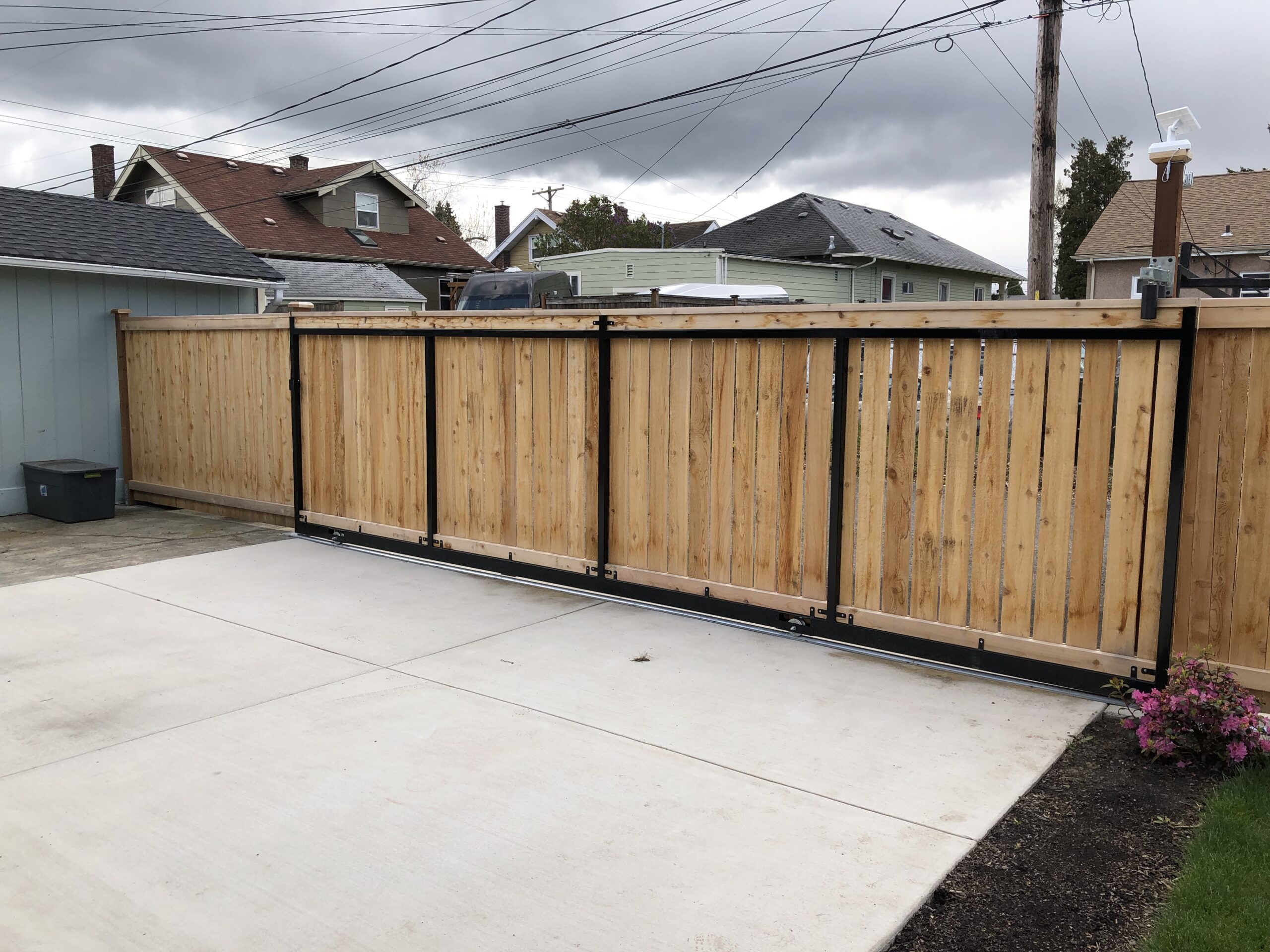
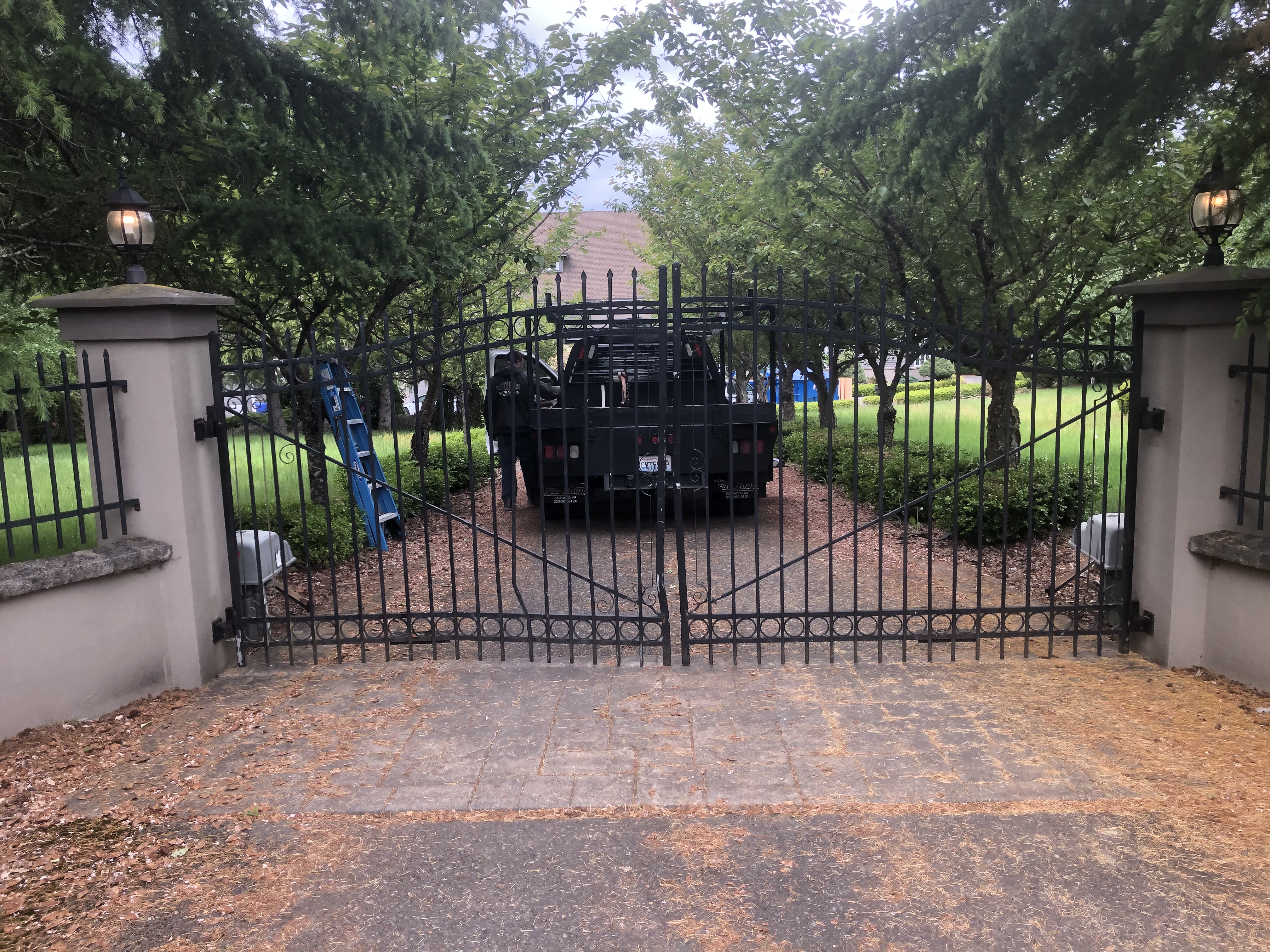
Everything above scales badly with width. A twelve-foot double drive gate applies vastly more leverage to its posts than a three-foot walk gate, and the usual residential approach of a wood post in a concrete hole is often not enough.
Wide and automated gates generally need posts sized to the actual gate weight and span, footings engineered rather than rule-of-thumb, and in many cases a cantilever roller system instead of swing hinges where space is tight. Once an automated operator is involved, post rigidity becomes a functional requirement rather than a longevity preference, because the operator will fight any movement and eventually damage itself.
We cover these systems on our gates and automation page.
What to Do Next
Start with the diagnosis. Check whether the latch gap is wedge-shaped or parallel, and sight the hinge post for plumb. That single observation tells you whether you are looking at a forty-dollar cable kit or a post reset.
If the post has moved, deal with it properly rather than adjusting around it, because the load that moved it has not gone anywhere. If you would like someone to look at it, we handle gate and fence repair across Tacoma and Pierce County. Request a free estimate.